The Quiet Negotiations

I watched Heated Rivalry like a lot of people and what stayed with me wasn’t the plot, the sport, or even the love story.
It was the recognition.
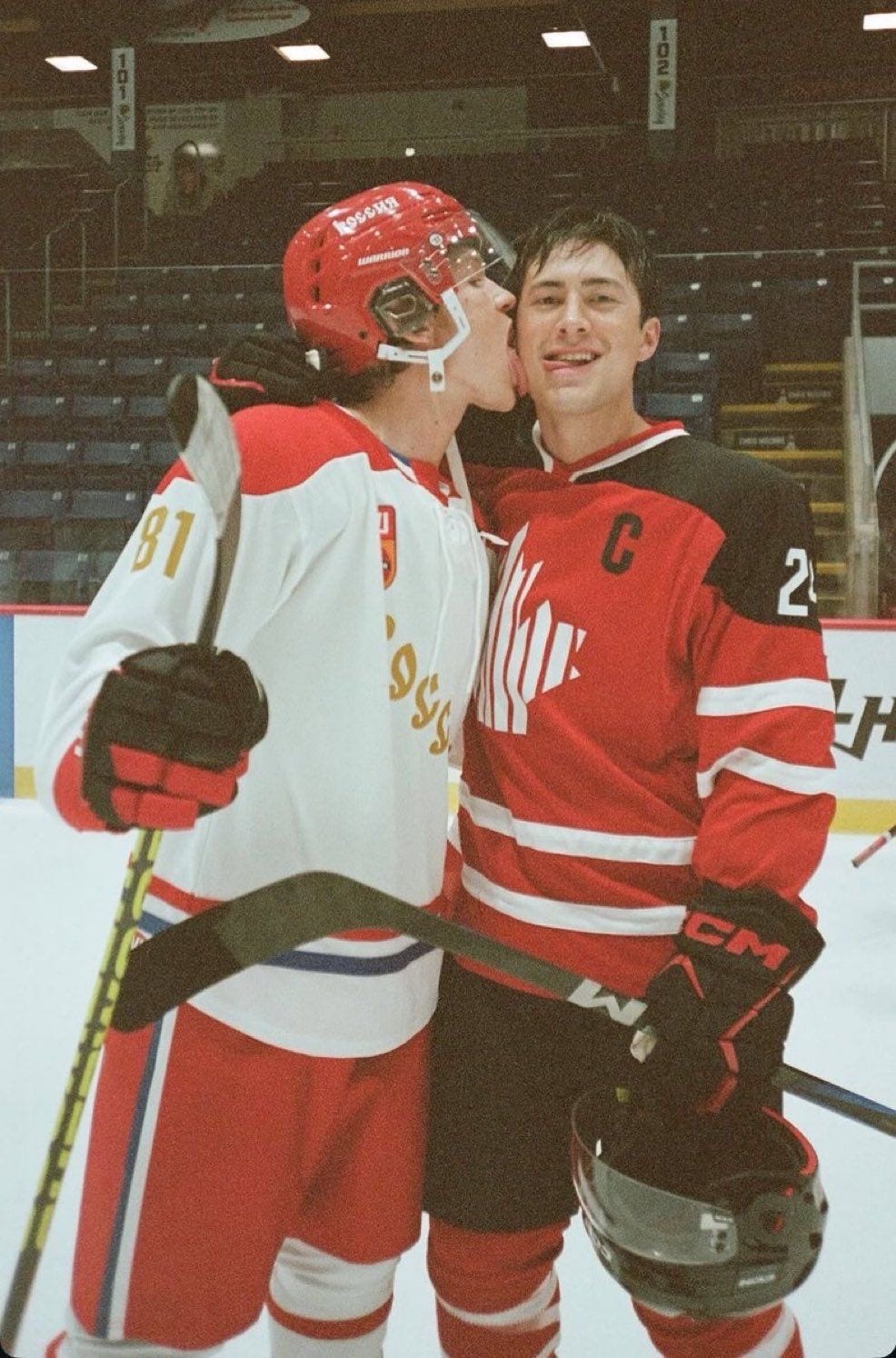
This was the first time I saw something on television that accurately reflected what I lived through…not externally, but internally. The calculations. The restraint. The constant negotiation between who you are and what the environment will tolerate.
I didn’t have to interpret the characters’ behavior or fill in emotional gaps. I understood them immediately. I knew why they paused when they did. Why certain choices felt safer than others. Why silence sometimes felt like intelligence rather than fear.
Because I had lived it.
What this story captures and what our culture still struggles to articulate, is that gay men in hyper-masculine spaces are not simply hiding. They are navigating systems that reward conformity and punish disruption. They are managing risk in environments where ambition, masculinity, and belonging are tightly policed.
That experience isn’t unique to sports.
Sports just make it easier to see.
In any institution built on hierarchy, performance, and control, there is an unspoken cost to visibility. You learn quickly that success isn’t only about talent. It’s about predictability. About not complicating the machine. Over time, that expectation becomes internalized, and self-regulation replaces self-expression.
You don’t disappear entirely.
You edit.
That kind of editing produces discipline. It also produces fragmentation.
One of the most important things this story does is refuse to frame coming out (or authenticity more broadly) as a singular, triumphant moment. Instead, it presents it as an ongoing negotiation between safety and truth. Between aspiration and risk. Between what you are allowed to be and what you are willing to sacrifice.
That framing matters.
Because our culture often treats visibility as a moral benchmark. If you are out, you are brave. If you are not, you are behind. But that binary ignores the reality of systems that still demand compliance before they offer protection.
For many people, especially those in high-stakes environments, silence is not confusion. It is strategy.
What struck me most was how accurately the story portrayed that internal tension without asking its characters to resolve it neatly. There were no speeches designed to educate. No moments engineered to reassure the audience. Instead, it allowed the discomfort to exist.
That choice felt honest.
It also felt important.
Because representation isn’t just about being seen. It’s about being understood. And understanding requires restraint, patience, and a willingness to depict people mid-process…not before the struggle or after it, but while it’s still unresolved.
That’s where most people live.
When stories get this right, they do something quietly powerful. They give context to experiences that are often misunderstood or dismissed. They allow people to recognize themselves without being asked to defend their choices or justify their timing.
They say:
You weren’t weak for waiting.
You weren’t dishonest for surviving.
You weren’t wrong for adapting to a system that wasn’t built for your whole self.
That kind of recognition has ripple effects beyond entertainment.
It changes how we talk about masculinity.
It complicates how we define courage.
It challenges institutions to ask whether the cost of success should include self-erasure.
Most importantly, it interrupts isolation.
Love, on its own, doesn’t dismantle systems. It doesn’t undo conditioning or erase fear. But recognition can shift something internal. It can loosen the grip of shame. It can offer language for experiences people didn’t know how to name.
Sometimes that’s enough to change the direction of a life.
Stories like this don’t sit at the intersection of sports and gay culture. They live in the space between identity and ambition, between belonging and self-preservation.
That space is quieter.
More complicated.
And far more common than we admit.
Seeing it depicted honestly, for the first time, felt less like entertainment and more like acknowledgment.
And that acknowledgment matters.
I had just finished the season when I saw your post, and I couldn’t sleep that night. I’ve adored you from the moment you appeared on my screen — your season of The Bachelor was my favorite because of you. Even then, it was clear how much you were carrying. When you shared your truth, I felt pure joy. I wanted nothing more than for you to be fully, unapologetically yourself.
I’m the mom of a gay, nonbinary 34-year-old. They are a magical human. More than anything, I want someone to love my child the way they deserve to be loved. I am endlessly proud of them for living authentically while navigating a system that isn’t always kind — they’re a doctor, so I know you can imagine the pressure and machinery of that world.
The morning after reading your words, I woke up emotionally undone. I knew I needed to rewatch HR through a new lens. Around the same time, my child told me they have a boyfriend — their first healthy, loving relationship after a painful one that left deep wounds. They told me, for the first time, they feel truly cared for — in words and actions.
Then they sent me a photo from a party. Red solo cups, people laughing — ordinary on the surface. But captured in the frame was something extraordinary. My child standing there, looking back over their shoulder at their boyfriend, who was casually, naturally holding them — one hand in a pocket, the other on their arm, leaning in, saying something just for them. My heart absolutely burst. In 34 years, I’ve never felt that kind of fullness seeing my child loved like that.
Your words, this beautiful show, and that moment in time collided in a way that filled my heart to the brim. Thank you for your honesty and your courage. Seeing your life now fills me with that same deep, instinctive joy — the kind only a mom can feel — and a profound sense of hope.
Thank you. 💙
i’m so glad we’ve got such series cause i think it’s so important for so many different people, and it makes people feel seen no matter if you’re a professional sport player or a person living in homophobic culture, it’s what unites us and i think it’s beautiful, thank you for your publication <3